|
Man's Day Clothes about 1738
This gentleman wears a smart summer suit, with the coat more tightly
fitting than at the end of the 17th century. It is made of plain
cloth embroidered on edges and pockets, which are raised to hip
level. The waistcoat is plain and the breeches are tighter and
fasten below the knee. The shirt is frilled at the cuff and around
the neck is a knotted muslin or lace cravat. He wears his own hair.
For formal occasions a powdered wig tied back with a bow would be
worn and his coat and waistcoat would be of patterned silks.
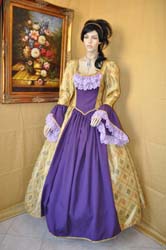
Lady's Day Dress about 1750
This lady (left) wears a 'sackback' dress developed from the flowing
undress gowns of 17th century. Beneath are a stiff corset and cane
side hoops supporting the skirts.
The frills of her shift show at the neck, veiled in a muslin 'kerchief'
and at the opening of her wing-like cuffs, which are typical of the
1750's. She wears a round muslin cap, the central pleat recalling
the 'fontange' (1690 - 1710). For formal dress she would wear richly
brocaded or embroidered silks.
Man's Day Clothes about 1770
This gentleman wears a plain coat, tightly fitting and cut away,
forming curving tails. The waistcoat is shortened to just below the
waist and the breeches are longer and tighter than before. His coat
has a band collar and he wears a rather stiff stock instead of a
cravat. He wears his own hair, but for formal occasions he would
have a powdered wig, dressed high and tied at the back. Embroidery
and trimming were no longer fashionable except for formal wear.
Lady's Day Dress about 1780
This dress is typical of the simple countrified styles which became
fashionable towards the end of the century. It is a 'redingote' or
riding coat, modelled on a man's coat. The waist has become shorter
and the bosom is padded by a muslin 'buffon' neckerchief and the
hips by a 'false rump'. The hair is dressed in a mass of loose curls
and the lady wears a huge hat inspired by a mid-17th century riding
hat. Woollen cloth, cotton and linen had become fashionable
materials, while silks were worn for evening, as were small hoops
since wide ones were only worn for court.
Lady's Formal Dress 1802
There was great interest at this time in ancient Greece and Rome,
and this lady wears 'fashionable full dress', the style based on the
drapery of classical statues. The waist is high and uncorsetted, and
the materials light in colour and texture. Muslin had become a
fashionable fabric. Her gown is still 18th century in cut, but for
day wear it would have bodice, skirt and petticoat in one piece. Her
accessories are varied: she carries a huge swansdown muff, wears
long white gloves, has a tasselled girdle and a feather-trimmed
turban.
In 1795, in order to raise revenue, a tax was imposed on hair powder
by William Pitt. However this tax failed as people promptly
abandoned the wearing of powdered wigs and the tax raised just
46,000 guineas.
Man's Day Clothes 1805
Informal day dress is shown here, the illustration taken from a
sketch portrait of George (Beau) Brummell, the fashionable ideal
(and famous dandy) of his age. He persuaded men to think that dark,
well cut and fitted clothes were smarter than colourful ostentatious
ones. He usually wore a cut-away cloth coat with brass buttons,
plain waistcoat matching his pantaloons (which replaced shorter
breeches in about 1805), hessian riding boots and a hard conical
riding hat, introduced in the late 18th century. Great care was
taken in the laundering and tying of his stiffly starched cravat.
For evening he wore a black coat and silk pantaloons instead of old
fashioned knee breeches.
'Beau' Brummell is credited with introducing and bringing to fashion
the modern man's suit worn with necktie; the suit is now worn
throughout the world for business and formal occasions.
Evening Clothes about 1806
The lady wears a one-piece dress introduced at the end of the 18th
century. Its design was inspired by the new interest in classical
works of art. It has a high waist, straight skirt unsupported by
petticoats and very short sleeves. Contemporaries found it daring
and immodest! The material is light and striped. For warmth she has
a shawl, wears long gloves and carries a muff.
The gentleman's cut-away tail coat of fine cloth with velvet collar,
silk stockings, tie wig and bicorne hat recall day clothes of the
18th century and anticipate the evening styles of the 20th century.
Formal dress is usually a day style which persists, remaining
unchanged though long since out of fashion.
The period after 1811 is known as the Regency period, as the Prince
of Wales (later King George IV) ruled as Regent from that time until
the death of his father George III in 1820.
The fashions of this era are quite familiar to us, as these are the
styles of dress portrayed in the popular TV adaptations and films of
Jane Austen novels, such as the 1995 Andrew Davies adaptation of
'Pride and Prejudice' for the BBC. ITV's Sharpe is based in this era
too, during the Peninsular and Napoleonic Wars.
The Napoleonic Wars were a series of conflicts fought between France
under the leadership of Napoleon Bonaparte and a number of European
nations, including Great Britain, between 1799 and 1815.
Day Clothes about 1825
The lady's dress assumes a new outline. The waist has dropped to
natural level and the sleeves and skirt are wide and full. The
colours are bright, trimmings elaborate and much jewellery is worn.
Accessories are varied, the most noticeable being the vast hat
trimmed with many ribbon bows.
The man wears elegant walking dress also with a slight fullness at
the shoulder and a waistcoat with lapels. He wears tight pantaloons
acceptable for day wear after about 1805 and wears a higher 'top'
hat.
Welsh Country Dress about 1830
This Welsh girl from a painting of about 1830, shows how fashion
lags behind in remote places. She wears a gown of 18th century cut,
over a stiff corset, a printed neckerchief and a petticoat protected
by a check apron. Her dress is probably made from Welsh woollen
material, her mittens and stockings being knitted. Her high crowned
hat can be traced back to 17th century fashions. Many wore a red,
caped cloak no different from that worn by English countrywomen in
the 18th and 19th century. This and the hat are the two essentials
of Welsh national dress as we know it today.
www.historic-uk.com
BRITISH COSTUME: FASHION THROUGH THE AGES
Part 1 - 1050 to 1490: 11th to 15th century
Part 2 - 16th and 17th centuries, Tudors and Stuarts
Part 4 - 19th and 20th centuries: The Victorians to the Swinging
Sixties
|
.JPG)
.JPG)
.JPG)
.JPG)
.JPG)
.JPG)
.JPG)
.JPG)
.JPG)
.JPG)
.JPG)
.JPG)
.JPG)
.JPG)
.JPG)